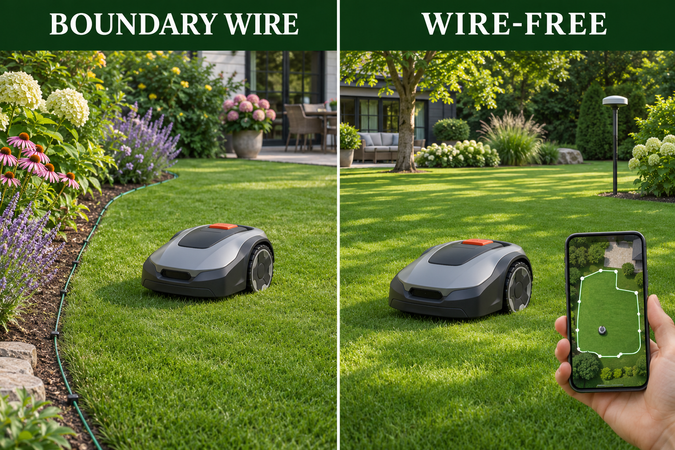
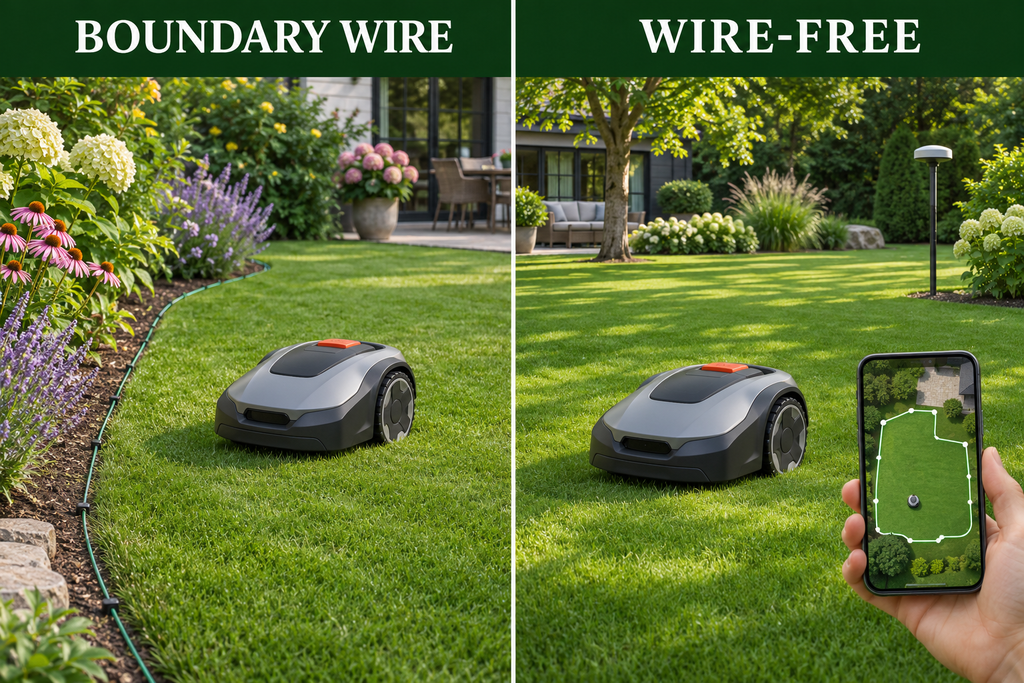
Comparing boundary wire vs wire-free robotic mowers starts with your yard’s layout. Wire-free sounds like the obvious choice until you look at the yard. Avoiding perimeter-wire installation is useful, but reliable navigation matters more than the label on the box. Start by checking how each system will handle your trees, buildings, passages and lawn edges.
This is a research-based explanation, not a hands-on product test or a ranking of particular models.
Contents
How boundary-wire mowers work
A physical wire defines the mowing perimeter and can surround areas to exclude. Depending on the system, a separate guide wire helps the mower reach remote lawn sections or return to its charger. Installation must follow the exact model’s distances, layout rules and electrical instructions.
The main practical advantage is that the boundary does not depend on an unobstructed view of positioning satellites. The tradeoff is installation and possible repairs after digging, edging or damage. A wire is not a physical safety fence.
Changing your lawn means changing the installation
If you expand a flower bed or add a patio, the perimeter may need adjustment. Plan wire routes before landscaping and keep an installation sketch. Do not assume every wired mower offers app-defined exclusion zones; features vary.
What “wire-free” actually means
Wire-free describes the absence of a perimeter wire, not a single navigation technology. Some models use satellite positioning with correction data; others use cameras, LiDAR or combined systems. They still need charging equipment, setup and clear operating boundaries.
Virtual boundaries can make layout changes easier. However, satellite positioning may be difficult beside buildings or under dense trees. Cameras and other sensors also have model-specific limits. Check the complete installation guide, including any requirements for a reference station, internet or cellular coverage.
Some compatible Husqvarna systems offer a support-wire option in weak satellite areas. That is a specific feature, not proof that every satellite mower can work around poor reception.
Boundary wire vs wire-free robotic mowers: practical comparison
| Question | Boundary wire | Wire-free |
|---|---|---|
| Initial setup | Install perimeter and any guide wire | Map boundaries and configure required positioning equipment |
| Layout changes | May require moving wire | May allow editing a virtual map |
| Key site check | Wire routes, passages and boundary clearances | Navigation coverage and model-specific limits |
| Maintenance concern | Locate and repair damaged wire | Maintain sensors, maps and any positioning hardware |
Five questions to ask before buying
- Will this exact model navigate the narrowest passage on my property?
- Can you demonstrate coverage beneath my trees and beside the house?
- What equipment and paid services are required?
- What happens when positioning or connectivity is lost?
- Can I return the mower if a documented site assessment proves wrong?
For a simple open yard, mapping flexibility may be attractive. For a complex site, a dealer demonstration is more valuable than a broad claim that one technology always works best.
Next, use our buying checklist and installation guide.
Boundary wire vs wire-free robotic mowers: your yard checklist
Before requesting a quote, sketch the lawn and mark every separate mowing area. Include narrow gates, paths, flower beds, trees and the proposed charging position. Measure the tightest passages rather than estimating them. Take photographs from several angles so the seller can assess the layout against the installation manual for the exact mower you are considering.
Then ask for two complete setup proposals. For a wired option, request a drawing of the proposed cable route and ask who handles future repairs. For a wire-free option, ask the seller to explain the navigation method and demonstrate how the proposed setup will cover difficult sections. Get any additional equipment and ongoing service charges listed in writing.
Make the final decision from the installation plan
For your boundary wire vs wire-free robotic mowers shortlist, score each proposal on installation effort, access to each lawn section, future layout changes and local support. If a seller cannot explain how a mower will handle a particular corner, leave that question open until they can demonstrate it. A clear installation plan gives you a stronger basis for choosing than the technology label alone.
Sources and review notes
Reviewed November 5, 2026. Sources: Husqvarna operating overview, EPOS mapping guidance, and support by wire.
How much could you save? Use our Labor Saver Calculator to estimate time saved, costs and payback for your mowing routine.